|
2026 Summer International Course Enrollment Notice-Introduction to Deep Learning and Artificial Intelligence
作者:
发布日期:2026-06-05
浏览次数:
Course Information Course Title (Chinese): 深度学习与人工智能导论 Offering Institutions: Course Duration: 32 class hours Enrollment Capacity: 5 International Students Course Schedule: · Online Instruction: July 5 – July 12, 2026 · On-site Instruction: July 13 – July 28, 2026 Concordia University Concordia University is a public comprehensive university located in Montreal, Quebec, Canada. It was established in 1974 through the merger of Loyola College and Sir George Williams University. The university is well known for its strong emphasis on both teaching and research, with particular strengths in engineering, business, computer science, art and design, as well as the humanities and social sciences. It is especially recognized for its practice-oriented education and interdisciplinary research initiatives. Concordia University offers a multicultural and internationally diverse campus environment, attracting students from around the world. The university maintains close partnerships with numerous companies and research institutions, providing students with abundant internship and career opportunities. Committed to innovation and social impact, Concordia University is also actively engaged in cutting-edge research areas such as sustainability, artificial intelligence, media, and the creative industries, demonstrating strong research vitality and influence in these emerging fields.
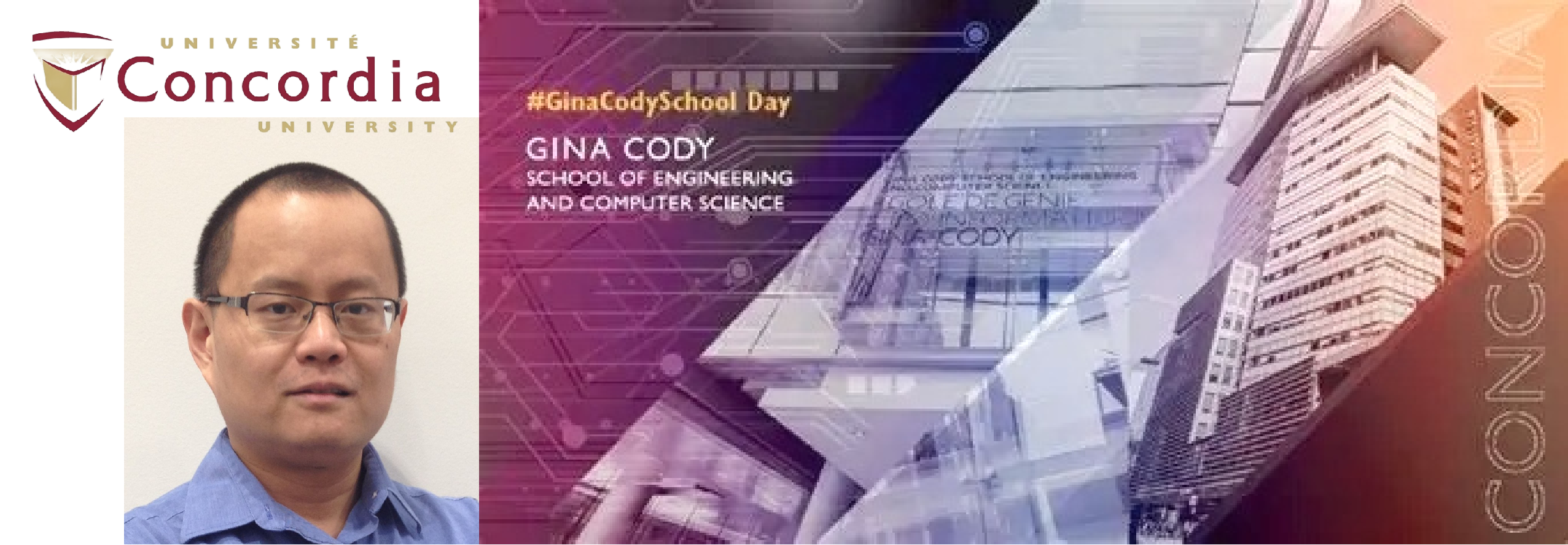
Visiting Expert Lecturer: Dr. Yang Wang is currently an Associate Professor in the Department of Computer Science and Software Engineering at Concordia University. Prior to joining Concordia University, he served as an Assistant Professor and later Associate Professor at University of Manitoba from 2012 to 2022. From 2020 to 2022, he worked full-time as Chief Scientist of Computer Vision (Vice President level) in the Consumer Business Group of Huawei Canada. Before that, he was an NSERC Postdoctoral Fellow at University of Illinois Urbana-Champaign. He received his Ph.D. from Simon Fraser University, his M.Sc. from University of Alberta, and his Bachelor of Engineering degree from Harbin Institute of Technology. His research focuses primarily on computer vision, machine learning, and deep learning. His work has received several honors and recognitions, including the Falconer Emerging Researcher Award in Applied Sciences (2017), the Faculty of Science Research Chair in Basic Science at the University of Manitoba (2019–2022), and first place in the ORBIT Few-Shot Object Recognition Challenge, with the related work presented at the CVPR 2022 VisWiz Workshop. His recent research aims to explore approaches for building AI models beyond conventional “brute-force supervised learning.” The ultimate goal is to develop AI systems that are more personalized, flexible, and capable of adapting rapidly to new scenarios at minimal cost. In pursuit of this vision, he has developed a range of machine learning methodologies, including meta-learning, test-time training, and continual learning. These techniques have been applied to various computer vision tasks, such as crowd counting, anomaly detection, video highlight extraction, image deblurring, point cloud analysis, and gaze estimation. Personal Homepage: https://users.encs.concordia.ca/~wayang/ Chinese Supervising Teachers:FAN Zhang, Ph.D. from Zhejiang University, is a faculty member at the School of Computer Science, Zhejiang University of Technology. He has long been engaged in teaching and research, primarily responsible for relevant courses within his school and actively participating in discipline development and talent training. In this summer international course, he is in charge of teaching organization and quality assurance, serving as a bridge and link throughout the course construction and implementation process. His responsibilities include overall course coordination, development of teaching resources, teaching support, and management of the teaching process, assisting the foreign lecturer in localizing course content and organizing instruction. By organizing classroom discussions, learning guidance, and formative assessments, he will closely monitor students’ learning progress and provides targeted guidance, facilitating students’ understanding and mastery of core knowledge in artificial intelligence and deep learning. In addition, he will oversee course administration, teaching feedback analysis, and continuous improvement, ensuring the achievement of high teaching quality and the internationalized training objectives of the course. Xiaoxin Li, Ph.D. from South China University of Technology, is currently a faculty member at the School of Computer Science, Zhejiang University of Technology. He has extensive experience in teaching, research, and talent cultivation in related fields. In this summer international course, he is responsible for practical teaching and the cultivation of students’ innovation abilities, focusing on laboratory instruction, course project guidance, and research training support. He will guide students in using deep learning platforms such as PyTorch, constructing and optimizing models, and solving real-world tasks including image classification, object detection, and semantic segmentation. Through organizing paper reading, project discussions, and presentations, he will foster students’ innovation awareness, research literacy, teamwork skills, and international academic communication abilities. Moreover, he will collaborate with the foreign lecturer in course assessment, promoting the integration of international advanced teaching concepts and practical experience, thereby enhancing the internationalization level of the course and the quality of talent training.
Course Features: This course is delivered entirely in English and provides a systematic introduction to the fundamental principles, core methods, and representative applications of Artificial Intelligence (AI) and Deep Learning in Computer Vision. Starting with the basics of machine learning and linear classifiers, the course gradually introduces neural network architectures and backpropagation algorithms. It then focuses on mainstream deep learning models, including Convolutional Neural Networks (CNNs), Recurrent Neural Networks (RNNs), and Generative Adversarial Networks (GANs), as well as their application scenarios. Topics covered include image classification, object detection, and dense image annotation tasks such as semantic segmentation. Through a combination of theoretical instruction and hands-on experiments, students will build and train models using the PyTorch framework. In addition, paper reading assignments and course projects will help students develop engineering practice skills, academic communication abilities, and teamwork competence, thereby laying a solid foundation for further study and research in cutting-edge AI technologies. Week 1 (Online Instruction): Weeks 2–3 (In-Person Instruction):
Basic Requirements and Selection Process: 1. Basic RequirementsThis course is primarily intended for second- and third-year undergraduate students who have completed prerequisite courses in Calculus, Linear Algebra, and Probability and Statistics. Applicants should possess a foundational understanding of artificial intelligence theory and Python programming, demonstrate strong initiative and adaptability in learning, and have good English communication skills and a strong sense of teamwork. 2. Application and Selection ProcessStudents who meet the above requirements should submit the application form electronically to 6279900@qq.com (Attention: Dr. Zhang) by 12:00 PM on Thursday, June 18. A final list of no more than 50 selected students will be announced. Students are encouraged to inform their classmates and apply as early as possible. Course Inquiries: Tel: (0571) 85290385 Contact Person: Dr. Zhang Click and download your Application Form and submitted: |